Selected publications
For a full list please visit Google Scholar
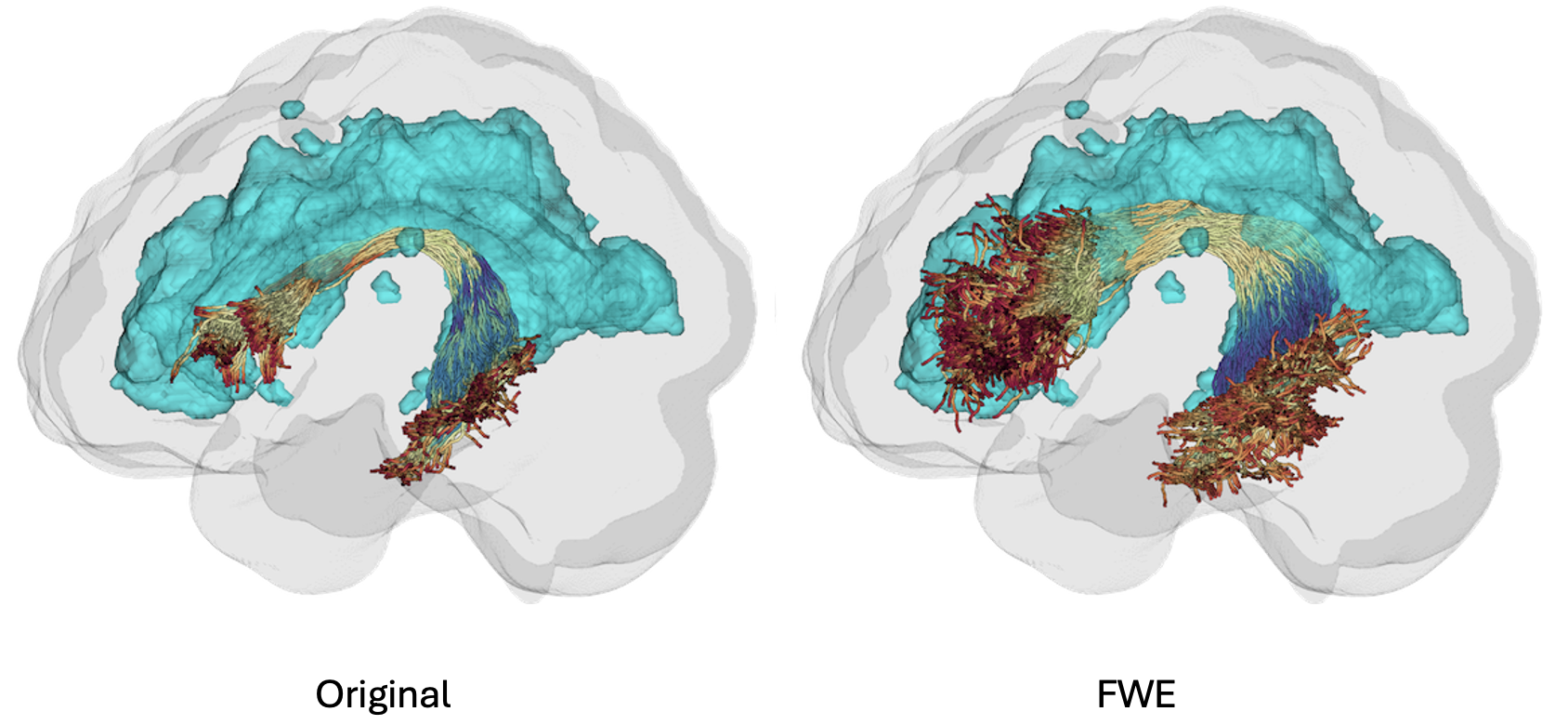
Tractometry of diffusion-weighted magnetic resonance imaging (dMRI) non-invasively quantifies tissue properties of brain connections. It is widely used in aging studies but could be less reliable in aging brains due to increased white matter free water. We demonstrate that computational free water elimination (FWE) and multi-shell multi-tissue (MSMT) modeling both increase the reliability and accuracy of tractometry in a large (n = 396) cohort of older adults (65-103 y.o.). We found substantial improvements in reliability in a split-half comparison at every stage of the pipeline: estimation of voxel-level fiber orientation distribution functions, delineation of major pathway trajectories, and assessment of tissue properties along the pathways. FWE in particular provided better tractography yield, that included more coverage of areas of leukoaraiosis. However, tractometry was strongly predictive of Fazekas scores, which assess the extent of white matter hyperintensity (WMH) burden, regardless of method. This indicates that increased WMH burden is associated with global changes to white matter. By sub-sampling a multi-shell dataset, we demonstrated that these findings generalize to single-shell data, which is important for many datasets where only one b-value may be available. Overall, the results highlight the importance of accounting for free water in tractometry studies, especially in aging brains. We provide open-source software for free-water elimination that can be applied to a wide range of clinical and research datasets (https://github.com/nrdg/fwe).
Kelly Chang, Luke Burke, Nina LaPiana, Bradley Howlett, David Hunt, Margaret Dezelar, Jalal B. Andre, Patti Curl, James D. Ralston, Ariel Rokem, Christine L. Mac Donald
Imaging Neuroscience 3: IMAG.a.991
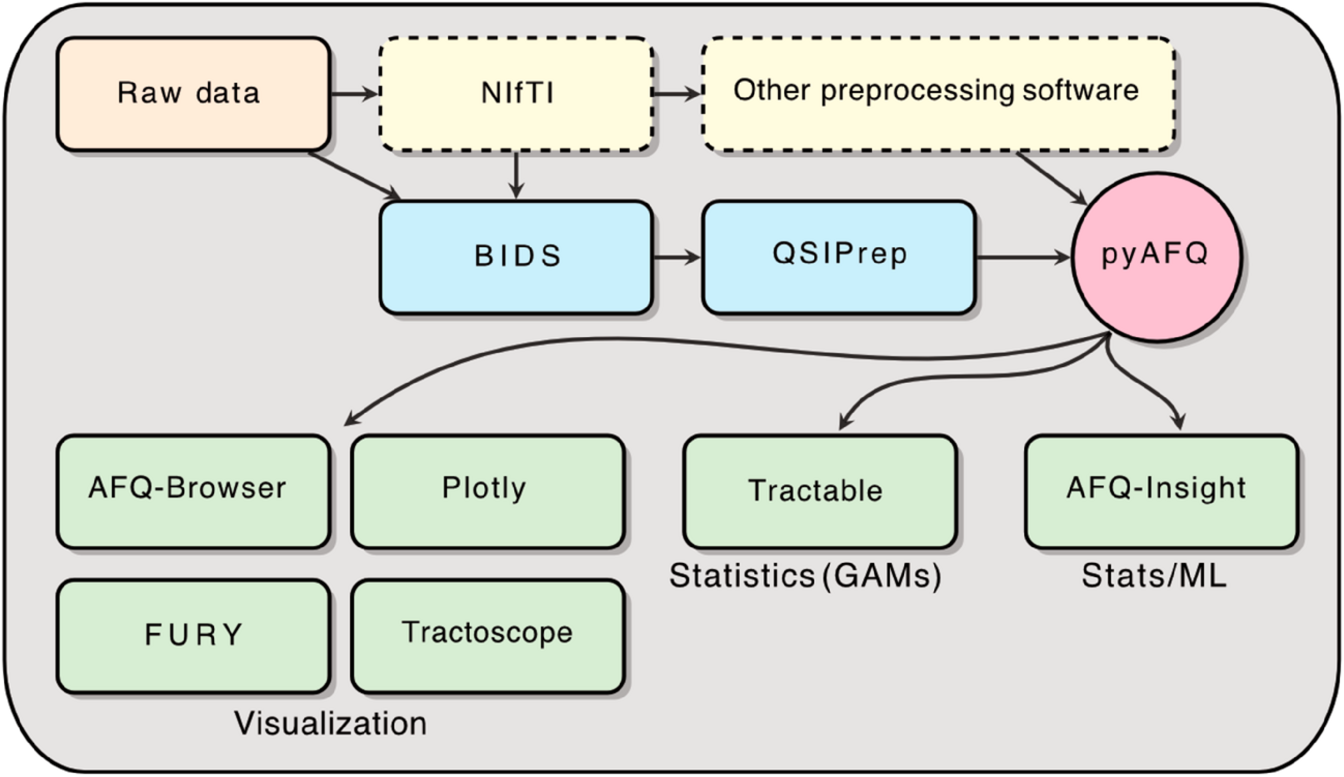
The human brain is a highly inter-connected system. Information about the environment and about internal states is effectively distributed and integrated through neural pathways that rapidly transmit signals between distant brain regions through large nerve fiber bundles. Measurements of diffusion MRI (dMRI) are sensitive to the trajectory of these nerve fiber pathways within the brain, and to their physical properties. We developed a suite of scalable open-source software tools that process dMRI data and delineate brain pathways and connections within it, quantifying the physical properties of brain tissue along the length of each pathway in an individualized manner. We demonstrate that the software is extensible to a variety of new studies, and offers useful approaches for visualization and statistical analysis, including novel machine learning tools. We also demonstrate that novel computational methods that we developed offer substantial speed-up, offering scalability for new large-scale datasets.
John Kruper, Adam Richie-Halford, Joanna Qiao, Asa Gilmore, Kelly Chang, Mareike Grotheer, Ethan Roy, Sendy Caffarra, Teresa Gomez, Sam Chou, Matthew Cieslak, Serge Koudoro, Eleftherios Garyfallidis, Theodore D. Satterthwaite, Jason D. Yeatman, Ariel Rokem
PLoS Comput Biol 21(8): e1013323.
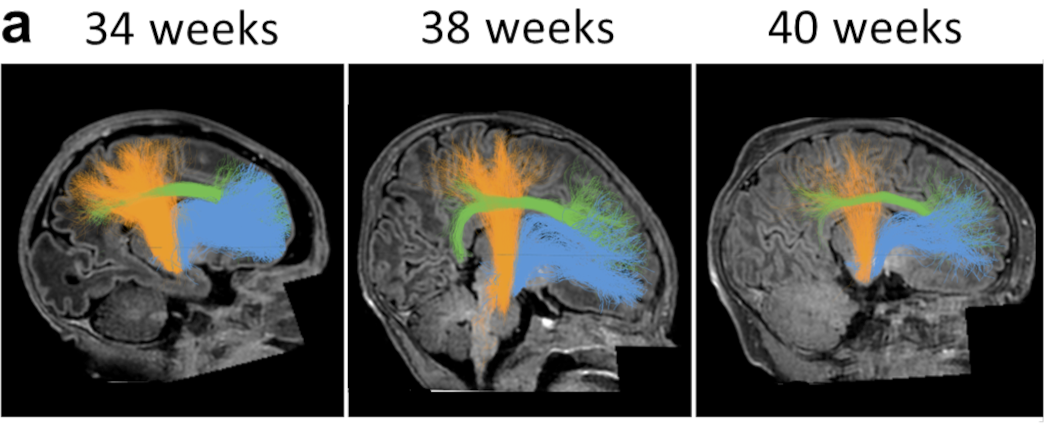
The formation of myelin, the fatty sheath that insulates nerve fibers, is critical for healthy brain function. A fundamental open question is what impact being born has on myelin growth. To address this, we evaluated a large (n=300) cross-sectional sample of newborns from the Developing Human Connectome Project (dHCP). First, we developed new software for the automated identification of 20 white matter bundles in individuals that is well-suited for large samples. Next, we fit linear models that quantify how T1w/T2w (a myelin-sensitive imaging contrast) changes over time at each point along the bundles. We found faster growth of T1w/T2w along the lengths of all bundles before birth than right after birth. Further, in a separate longitudinal sample of preterm infants (N=34), we found lower T1w/T2w than in full-term peers measured at the same age. By applying the linear models fit on the cross-section sample to the longitudinal sample of preterm infants, we find that their delay in T1w/T2w growth is well explained by the amount of time they spent developing in utero and ex utero. These results suggest that white matter myelinates faster in utero than ex utero . The reduced rate of myelin growth after birth, in turn, explains lower myelin content in individuals born preterm, and could account for long-term cognitive, neurological, and developmental consequences of preterm birth. We hypothesize that closely matching the environment of infants born preterm to what they would have experienced in the womb may reduce delays in myelin growth and hence improve developmental outcomes.
Mareike Grotheer, David Bloom, John Kruper, Adam Richie-Halford, Stephanie Zika, Vicente A. Aguilera González, Jason D. Yeatman, Kalanit Grill-Spector & Ariel Rokem
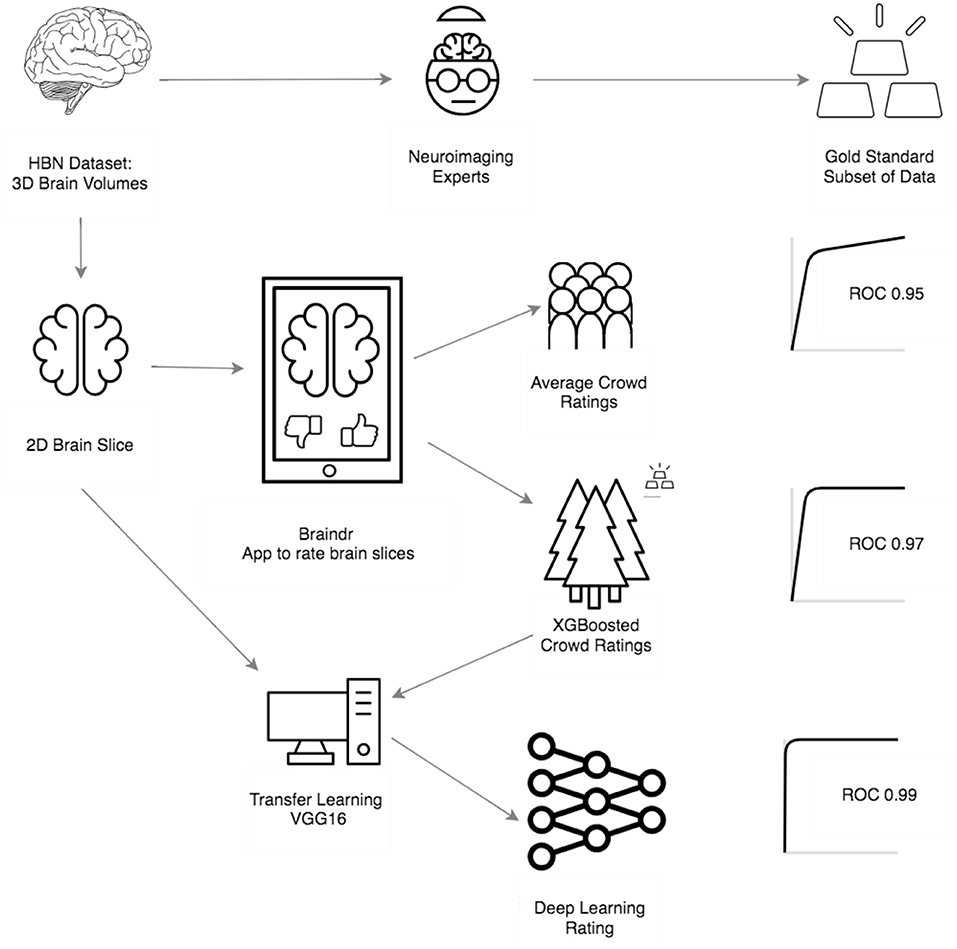
Combining citizen science and deep learning can generalize and scale expert decision making; this is particularly important in disciplines where specialized, automated tools do not yet exist. In Braindr, expert-labeled data were amplified by citizen scientists through a simple web interface. A deep learning algorithm was then trained to predict data quality, based on citizen scientist labels. Deep learning performed as well as specialized algorithms for quality control (AUC = 0.99).
Anisha Keshavan, Jason Yeatman & Ariel Rokem
Frontiers in Neuroinformatics, 13: 29